
PERFORMANCE EXCELLENCE THROUGH PASSION,
COMMITMENT & COMMUNITY

ORIANA PRESENTS: JS BACH’S ST MATTHEW PASSION
With Sinfonia of St Andrews
Featuring Sunshine Coast Youth Choir
Conducted by Kim Kirkman
Soloists: Liam Jackson, Jason Barry-Smith, Michelle Bull and Anne Fulton
ARTIST BIOGRAPHIES
ORIANA ARTS INC
Conductor and Oriana Artistic Director – Kim Kirkman
After originally training as a violist (B Mus), Kim moved to voice (Post Grad Dip) and became co-owner, musical director and member of The Ten Tenors. He has sung solos in oratorios in Cairns, Townsville, Mackay and Brisbane as well as solo and chorus for Opera Queensland and the Victorian State Opera.
Having a very varied career, he has conducted many choirs (Blackstone Ipswich Cambrian Choir, Mackay Choral Society, Bach Society of Queensland etc), orchestras (Gold Coast Philharmonic etc) and mixed ensembles in Australia and overseas; as well as working as a script-writer, administrator, composer and teacher.
Kim taught strings, composition, conducting, music technology and voice at the Central Queensland Conservatorium of Music, CQUniversity, Mackay from 2004 to 2012. He also gained a Masters of Learning Management.
He is a multi-instrumentalist and gives many concerts every year performing on harp, violin and voice. Kim also performs as ‘Michael of Canterbury’, a fictitious troubadour from 1430, playing vielle and gothic harp. Recent performances include the Abbey Medieval Festival and the Woodford Folk Festival.
Kim currently conducts the Inspiration Choir, Inspiration Project Choir, Caloundra Community Choir, Noosa Chorale and the Caloundra Chorale and is in high demand as an adjudicator and vocal workshop leader.
He has written the accompanying scripts for two Purcell semi-operas as well as The Messiah and the Man (a Veteran's journey to peace accompanied by arias and choruses from Handel's Messiah).
Kim arranges harp, orchestral, choral and violin scores to sell online and has over 500 works published on sheetmusicplus.com. His arrangements vary in style from Bach to Taylor Swift. He also writes rounds every week for one of his choirs and has published 300 of them.
Oriana Official Accompanist (and Continuo Organist) – Denis Feletto
Denis Feletto is a pianist, composer, arranger, and music educator based on the Sunshine Coast. He brings a broad and versatile musical background to his work as a collaborative pianist, with extensive experience accompanying choirs, instrumentalists, and student musicians in both educational and performance settings. His playing is informed by a strong grounding in classical repertoire, alongside a deep appreciation for contemporary styles, ensemble collaboration, and the expressive possibilities of live performance.
As a composer and arranger, Denis has worked across a range of musical contexts, including concert music, theatre, and screen projects. He enjoys creating music that is both practical and imaginative, and values the close connection between performer, accompanist, and audience. Alongside his performance work, Denis is passionate about music education and mentoring young musicians, helping them develop confidence, artistry, and a love of music-making.
Denis is delighted to be part of the Oriana artistic family and to contribute his experience as a pianist and collaborator to the choir's vibrant musical life.
Sunshine Coast Youth Choir
Click here for information on Sunshine Coast Youth Choir
SOLOISTS

Liam Jackson – The Evangelist
Liam Jackson is an emerging Australian tenor based in Brisbane. He recently completed a tour of Queensland schools in the role of Count Almaviva in Opera Queensland and Shake & Stir’s production of The Adventures of Figaro (2025-2026). During the tour, he performed at the Opera Ball as part of Opera Queensland’s 2026 Festival of Outback Opera.
In 2026, Liam will perform the Australian premiere of Iain Bell’s monodrama, Comfort Starving, as part of Voxalis Opera’s Triple Bill season, marking the first Australian performance of any of Bell’s works.
His other professional credits include Frederic in The Pirates of Penzance with Kirkman & Scott Productions, as well as a member of the Pirate Chorus in Prospero Arts’ production at QPAC, Rudolph in Schubert’s Der häusliche Krieg with the Lisa Gasteen National Opera Program, The Soldier in Stravinsky’s The Soldier’s Tale, The Servant in Springboard Opera’s production and regional tour of The Boor, and a supernumerary role in The Australian Ballet’s 2023 production of Swan Lake.
Liam recently completed both his Bachelor of Music (Performance) and Postgraduate Certificate of Music at the Queensland Conservatorium Griffith University. During his studies, his roles included Eumete in Monteverdi’s Il ritorno d’Ulisse in Patria, John Styx in Offenbach’s Orpheus in the Underworld, and covers of Rinuccio in Puccini’s Gianni Schicchi and Lord Tolloller in Gilbert and Sullivan’s Iolanthe.

Jason Barry-Smith – The Voice of Christ, Bass soloist
Jason Barry-Smith’s study in Brisbane, Munich, London and Rome led him to a career on the Australian operatic stage, and he is equally in demand as a teacher, conductor, arranger, director, and compère.
Over the past three decades Jason has performed in or directed many of Opera Queensland’s most successful productions and programs. His operatic roles include the Marchese in La traviata, Sir Despard in Ruddigore, Dandini in Cinderella, Pish-Tush in The Mikado, Bello in The Girl of the Golden West, Danilo and Baron Zeta in The Merry Widow, Papageno in The Magic Flute, Guglielmo in Così fan tutte, Eisenstein and Dr. Falke in Die Fledermaus, Mercutio in Romeo & Juliet, Schaunard in La bohème, and the title roles of The Barber of Seville and Don Giovanni.
Jason has also worked with the Brisbane Biennial Festival of Music, Opera Australia, Brisbane Festival, 4MBS Festival, Queensland Symphony Orchestra, Sydney Symphony Orchestra, Melbourne Symphony Orchestra, Tasmanian Symphony Orchestra, State Opera of South Australia, West Australian Opera, New Zealand Opera, Wellington Operatic, Queensland Music Festival, Essgee Entertainment, Opera 21 (Belfast), NORPA, New Zealand Arts Festival, and the Tokyo Arts Foundation.
He’s also a well known singing teacher and musical director who specialises in community based arts projects, he’s a regular conductor of choirs as part of QCGU’s Open Conservatorium SHEP and AHEP programs, and has held the positions of Sessional Singing Teacher - Queensland Conservatorium, Griffith University; Artistic Director - Queensland Youth Choir; Director - Young and Developing Artist Program at Opera Queensland; and Creative Director - Open Stage at Opera Queensland.

Michelle Bull – Soprano soloist
Michelle Bull is a Sunshine Coast–based soprano and graduate of the Queensland
Conservatorium, whose work encompasses opera, classical concert repertoire, cabaret and musical theatre.
A versatile performer, Michelle has appeared at the Italian Australian Film Festival, Adelaide Fringe Festival and Woodford Folk Festival, and performs regularly at festivals, community events and corporate engagements across the Sunshine Coast, Australia and the UAE. She has toured nationally with acclaimed ensembles including Belladiva, Babushka Cabaret and ChiChi DeluX
Recent engagements include Viva Vivaldi with Noosa Chorale, the role of Mabel in Kirkman and Scott’s The Pirates of Penzance, as well as multiple roles in Kirkman and Scott’s The Best of Broadway 1 & 2. In addition to performing as the soprano soloist in Bach’s St Matthew Passion, she will also appear as soprano soloist with The Project Choir in their production of Mostly Mozart.
Alongside her performing career, Michelle teaches voice at Sunshine Coast Grammar School and is co-director of Tempo Allegro School of Music in Mooloolaba, where she teaches singing and mentors emerging vocalists.

Anne Fulton – Contralto soloist
Mezzo-soprano Anne Fulton has enjoyed an established performing career, appearing with many of Queensland's leading arts organisations, including Opera Queensland, Opera Australia, Queensland Symphony Orchestra, Underground Opera, Canticum Chamber Choir, Camerata, Brisbane Chorale, The Bach Society of Queensland, Brisbane Chamber Choir, Sunshine Coast Oriana Choir, Sunshine Coast Choral Society, Queensland Ballet, and the Queensland Youth Symphony Orchestra.
As a concert soloist, Anne has performed extensive and diverse repertoire, including Handel's Messiah; Bach's Mass in B Minor, St Matthew Passion, St John Passion, and Christmas Oratorio; Mozart's Coronation Mass and Requiem; Mendelssohn's Elijah; Arvo Pärt's Passio; and Mahler's monumental Symphony No. 2 ('Resurrection').
Throughout her career, Anne has been featured as a soloist in numerous Brisbane Festival events and Opera Queensland concerts. A principal artist and longstanding member of the Opera Queensland chorus since 1995, she made her company debut as Kate Pinkerton in Madama Butterfly and Giovanna in Rigoletto.
Anne has since appeared in a wide range of productions, including Carmen, Turandot, Madama Butterfly, Il Trovatore, La Traviata, Faust, The Mikado, L'elisir d'amore, The Magic Flute, Lucia di Lammermoor, The Merry Widow, Candide, Peter Grimes, and Aida, establishing herself as a respected and versatile performer across both operatic and concert stages.
These Oriana Choir members sing solos/duets through the performance:
Ian Rix as Judas, Leon Meintjes as Peter, Sarah Laws and Melissa Innes as Maids, Gabrielle Deschamps as Pilate’s wife, and with and Bruce Tasker as the False Witnesses, James Kluck and Rafael Innes as the High Priests, and Jon Watson as Pilate.
SINFONIA OF ST ANDREW’S
Founded in 1995, the Sinfonia of St Andrew’s is a vibrant ensemble that brings together a rich tradition of classical music performance. Over the decades, the ensemble has become an intrinsic part of Brisbane’s cultural landscape.
The orchestra consists of professional musicians from across Brisbane, coming together to create a dynamic and engaging sound. This diverse group performs a wide range of repertoire, from the elegance of the Baroque era to the depth of the Romantic period, keeping the spirit of classical music alive and accessible.
Performances extend beyond Brisbane, reaching regional centres and communities around South East Queensland. Through collaborations with local groups such as the Queensland Choir, Oriana Choir, Brisbane Chorale, the Queensland University Music Society, and the Ipswich Cambrian Choir.(full stop instead of comma) Sinfonia continues to share the joy of music with an ever-growing audience.
Sinfonia is committed to nurturing talent, encouraging young musicians to perform alongside experienced professionals and providing valuable opportunities for growth. This approach has included performances featuring acclaimed artists such as violinist Ray Chen and pianist Alex Raineri, reflecting the ensemble’s ongoing support for the next generation of musicians.
Sinfonia is an active part of Brisbane’s music scene, collaborating with choirs, organisations, and individuals on a wide range of musical projects. The ensemble continues to share its passion for classical music through performances, partnerships, and community engagement.

Warwick Adeney – Orchestra Leader
Warwick Adeney was born into a large family of violinists and trained at Queensland Conservatorium alongside three of his siblings. There he learnt with Dr Anthony Doheny and emerged as the Gold Medal graduate of 1984. He immediately joined (back space to fill this gap)
Queensland Theatre Orchestra under Georg Tintner, and rose to be concertmaster in 1989. During the nineties, Warwick played many solos with the orchestra (now the QPO) including the memorable Lark Ascending with Sir Neville Marriner, and directed many concerts, especially of Baroque music. In 2001, the amalgamation of orchestras in Queensland occurred and Warwick served as leader with Alan Smith initially and then on his own for many rich? years, under conductors Michael Christie, Johannes Fritzsch and Alondra de la Parra. Over his many years in QSO Warwick (back space to fill this gap)
experienced the privileged life of the orchestra, relishing the variety of musical challenges from schools (delete this plural?)shows to opera and ballet and premier symphony concerts.
Early in 2024 Warwick retired from the orchestra, in a special concert of Beethoven's Ninth Symphony conducted by new chief conductor Umberto Clerici. He is now busy teaching and playing in and around Brisbane.
Married to Michele, a fellow musician, Warwick Adeney is blessed with a large family, all of whom have learned a variety of instruments, and they sing chant at a weekly traditional Latin Mass together.
The violin Warwick plays is a Venetian instrument from the early 18th century, probably by Carlo Antonio Testore.
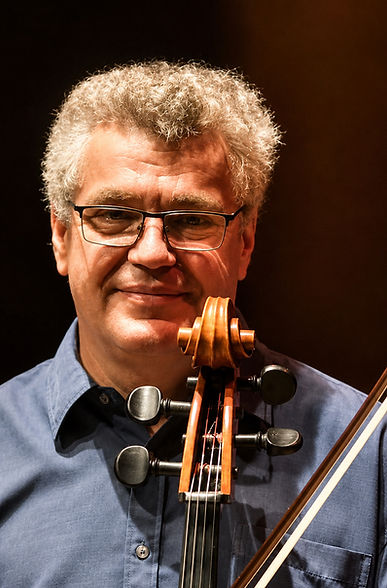
György Deri - Continuo Cellist
Gyögy Deri was born in 1965 and began playing cello at the age of six. In 1983 he began studying at the famous Franz Liszt Academy of Music in Budapest. He graduated with a diploma summa cum laude and, in 1991, began teaching at the Teachers’ Training Institute of the Franz Liszt Academy of Music. In 2008 he became an associate professor and in 2012, he completed his doctoral studies.
Over 40 years, Gyögy has given regular concerts, recorded CDs and performed on numerous radio programs. He has received many awards including the Franz Liszt Prize in 2004 and the Artisjus Award (five times) for contributions to Hungarian music.
As a soloist he has played with many orchestras including the Symphonic Orchestra of the Hungarian Radio conducted by Zoltán Kocsis, the Franz Liszt Chamber Orchestra conducted by János Rolla and the UMZE Chamber Orchestra conducted by Péter Eötvös. He was also a member of chamber groups, for example, The Keller Quartet, Trio Art Nouveau and The Pestalozzi Trio.
Gyögy has been a member of contemporary ensembles such as UMZE, Intermoduláció and Componensemble. He has premiered and personally commissioned many new works. In 2009 he was appointed deputy head of the String department and head of Cello, Double Bass and Viola Departments at the Franz Liszt Academy of Music. Many of his students have won prestigious prizes and achieved success as soloists.
In 2020 he was appointed senior lecturer at the prestigious Queensland Conservatorium, Griffith University. In 2021 he established a piano-cello duo with colleague, Roger Cui.
JOHANN SEBASTIAN BACH: A LIFE IN MUSIC
Johann Sebastian Bach (1685–1750) was born into one of Europe’s most remarkable musical families. Generations of Bachs had worked as organists, town musicians and church musicians across central Germany, and music surrounded him from childhood. He was orphaned by the age of ten and went to live with his elder brother Johann Christoph, an organist who helped continue his musical education. As a teenager Bach sang in school choirs, studied organ and absorbed the rich traditions of German church music. He was also intensely curious about the music of others, travelling, copying scores and learning from composers whose styles he admired.
His early career took him through Arnstadt, Mühlhausen, Weimar and Köthen. He became known as a formidable organist, a brilliant improviser and an exacting musician with very high standards. At Weimar he developed as a composer of organ and church music; at Köthen, where his duties were largely secular, he produced some of his best-known instrumental works. His personal life was marked by both devotion and loss. His first wife, Maria Barbara, died suddenly in 1720. The following year he married Anna Magdalena Wilcke, a professional singer. Between his two marriages Bach fathered twenty children, though only ten survived to adulthood. Several became important musicians in their own right.
In 1723 Bach moved to Leipzig to become Thomaskantor, responsible for music at the city’s principal churches and for the musical education of the boys at St Thomas School. The position was prestigious but demanding. He had to train singers and instrumentalists, teach, rehearse, organise music for several churches and provide new works for the liturgical calendar. In his first years in Leipzig he composed sacred music at an astonishing pace, including weekly cantatas and the great Passions. The ST MATTHEW PASSION belongs to this extraordinary period of creative intensity.
THE WORLD OF THE ST MATTHEW PASSION
The work was first performed in Leipzig on Good Friday, 11 April 1727. In Bach’s Lutheran world, the Passion story was not presented as concert entertainment. It formed part of the Good Friday Vespers service, with the two parts of the Passion placed around the sermon. The congregation already knew the Gospel story intimately. Bach’s task was therefore not simply to tell them what happened, but to make them encounter it afresh: to hear the words, feel their weight, recognise themselves in the story and reflect on its meaning.
The biblical narrative comes principally from chapters 26 and 27 of St Matthew’s Gospel. Around it, Bach and his librettist Christian Friedrich Henrici, known as Picander, placed poetry for arias and reflective movements, while familiar Lutheran chorales gave the congregation a musical and spiritual point of connection. Bach’s surviving fair copy shows how highly he valued the work: he prepared it with exceptional care, even using red ink to distinguish biblical words and chorale melodies. The result is monumental in scale, yet profoundly intimate. It moves continually between public drama and private reflection, between the historical events of the Passion and the listener’s own emotional response.
Bach spent the final twenty-seven years of his life in Leipzig. Although later generations temporarily regarded some of his music as old-fashioned, his reputation as a master never disappeared among musicians. Since the nineteenth-century revival of the ST MATTHEW PASSION, his music has become central to the classical repertoire. Its extraordinary combination of architecture, emotion, theology and human insight is one reason Bach remains, for many, one of the most profound musical minds who ever lived.
HOW BACH TELLS THE PASSION STORY
The ST MATTHEW PASSION works on several levels at once. The Evangelist, sung by a tenor, is the narrator: he carries the Gospel story forward with remarkable urgency and flexibility. Jesus is given to a bass voice, often surrounded by sustained string sonorities that create a distinctive musical halo. Other characters step briefly out of the narrative, while the choir becomes disciples, priests, soldiers and crowds. At other moments the choir sings chorales, representing a reflective community looking back on the events. The solo arias suspend the action altogether, allowing time for grief, compassion, fear, devotion and self-examination.
Bach divides his forces into two choirs and two orchestras. They can answer one another, overlap, question, accuse, comfort or combine into a single overwhelming body of sound. The continuo players provide the harmonic foundation beneath much of the work, while individual instruments become expressive partners to the singers. Oboes can ache, flutes can seem to hover, strings can tremble or console, and a solo violin can turn a single aria into something almost unbearably personal. Bach does not merely accompany words. He makes the orchestra interpret them.
PART ONE: FROM PROPHECY TO ARREST
Part One begins before the Gospel narrative itself. In the great opening chorus, one choir calls the listener to witness Christ’s suffering while the other questions and responds. Above them, a chorale melody invokes the Lamb of God. From the outset Bach places several perspectives in the room at once: narrator, believer, observer and mourner. The Passion then unfolds through the plotting of the authorities, the anointing at Bethany, Judas’s betrayal, the preparation of the Passover and the Last Supper.
The pattern is crucial. The Evangelist tells us what happens; characters speak within the story; the choir suddenly becomes the crowd; then time seems to stop for an aria or chorale. These reflective movements allow us to step inside the emotional meaning of the action. An alto grieves over sin, a soprano responds to betrayal and loss, and the chorales repeatedly turn the ancient story toward the present listener. At the Mount of Olives, Peter promises loyalty, Jesus enters Gethsemane and the music becomes increasingly inward. In the tenor aria “I would beside my Lord be watching”, the singer’s desire to remain faithful is answered by the choir, binding private devotion to communal response.
The arrest brings Bach’s dramatic imagination to full intensity. The soprano and alto lament that Jesus has been taken while the chorus erupts around them. Tenderness and violence occupy the same musical space. Part One closes not with action but with contemplation: the great chorale “O man, thy grievous sin bemoan” draws the first half into a broad meditation on the meaning of what has begun.
PART TWO: TRIAL, CRUCIFIXION AND BURIAL
Part Two begins in the court of Caiaphas and moves steadily toward the Cross. The atmosphere becomes harsher. False witnesses accuse Jesus, crowds condemn him and Peter denies him. Yet Bach repeatedly interrupts the public brutality with music of extraordinary intimacy. After Peter’s denial, the alto aria “Have Mercy, Lord” is accompanied by a solo violin whose long, pleading line seems to speak beyond words. It is one of Bach’s most remarkable examples of an instrument becoming a second emotional voice.
The story proceeds through Judas’s despair, the hearing before Pilate, the choice of Barabbas, the call for crucifixion, the scourging, the crowning with thorns and the journey to Golgotha. The two choirs can become a terrifying crowd, yet Bach never allows the work to become simple spectacle. Chorales repeatedly draw us away from blame and toward reflection. The listener is asked not merely to watch the drama but to recognise human weakness, fear, betrayal and compassion within it.
At the Crucifixion, the musical world gradually empties. Jesus’s final words are followed by a chorale of extraordinary stillness. After his death, the narrative turns toward burial and farewell. The bass aria “Make thee clean, my heart” transforms grief into an inward act of preparation. In the final movements, solo voices and choir gather around the body of Christ, each offering a last farewell. The closing chorus does not end in triumph. It settles into sorrowful rest, with the repeated invitation to “sleep in peace”. Bach leaves the listener at the tomb, not with a theatrical conclusion, but with space for silence, grief and reflection.
That is part of the work’s genius. Bach makes theology dramatic without making it superficial, and makes drama devotional without losing its humanity. The Gospel text tells the story; the Evangelist propels it; the characters inhabit it; the choirs surround it; the chorales reflect upon it; the arias open its emotional interior; and the orchestras give colour, movement and meaning to almost every word. Across nearly three centuries, the ST MATTHEW PASSION continues to feel immediate because Bach asks us not simply to hear what happened, but to enter the story.